Quick Answer: At Carolina Anchor Psychological & Educational Consulting, the psychoeducational evaluation process is a five-stage sequence: intake meeting, records and questionnaire collection, individually administered assessment appointments, a feedback session, and a written report with recommendations. The process often spans four to eight weeks from first contact to receiving the written report. It is designed to give families a clear, actionable picture of how a child, adolescent, or young adult learns and where support is needed, not just to deliver a single diagnostic label in one visit.
If you are reading this, you are likely in the uncertain middle. A teacher flagged a concern. A school sent a letter about a 504 or IEP meeting. A young adult just received a request for “documentation of a learning difference” from a college disability office. Or you have felt it for a while: the homework battles, the reading that does not match the child’s ability in other areas, the grades that quietly slipped after summer. You are trying to figure out whether an evaluation is the right step and what it will actually look like when it arrives.
Carolina Anchor Psychological & Educational Consulting helps families in Mount Pleasant and the broader Charleston area move through that uncertainty. What follows is the full roadmap: every stage from the first conversation to the final feedback session, what happens at each step, how long each piece takes, and what to do with the results once they are in hand.
What Is a Psychoeducational Evaluation?
A psychoeducational evaluation is a structured, multi-session assessment that examines cognitive, academic, social-emotional, and behavioral functioning to explain how a child, adolescent, or young adult learns and where the friction points are. It produces a written profile with recommendations for academic supports, accommodations, interventions, and referrals.
It is not a single test. It is not a diagnosis handed over in a waiting room. It is not a substitute for counseling, tutoring, or school-based intervention. It is a process that moves through intake, records review, assessment, feedback, and written findings.
Evaluations help families and professionals explore concerns such as:
- Learning disabilities including dyslexia, dysgraphia, and dyscalculia
- ADHD or attention-related patterns that interfere with academic performance
- Anxiety, mood, or behavioral concerns that disrupt learning
- Executive function challenges: planning, organization, self-regulation, task initiation
- Processing differences that affect reading, writing, or math comprehension
Families who reach out to Carolina Anchor Psychological & Educational Consulting are usually not looking for a label. They are looking for an explanation specific enough to act on. The evaluation is built to deliver that explanation, and the multi-stage structure helps make the result more useful and grounded in the child’s own context.
Why Understanding the Process Helps Families Prepare
A common misconception is that the evaluation is a single event: you pick a date, you show up, you get results. That framing creates stress at the wrong moments. By the time the testing day arrives, records are missing, forms are unsigned, and the child may walk in confused about why they are there. The process can break down not because of the child, but because of logistics no one planned for.
The evaluation process begins well before the testing day. It starts with a first conversation, a records request, and a set of questionnaires that shape what testing looks like when the time comes. Families who understand the full sequence tend to find the assessment stage less stressful than they expected. The testing day becomes one step in a plan rather than the whole plan itself.
The start of the school year is a common trigger. New teacher feedback arrives. Grade reports land. Schools issue 504 or IEP meeting notices. Families then have a narrow window to decide whether an evaluation makes sense, gather records from the district, and schedule before the school calendar locks in. Having a clear map at that moment can shorten the timeline. Without it, weeks can slip while families are still deciding what is needed.
Step 1: The Intake Meeting or Initial Consultation
The intake meeting is the first substantive step, and it shapes everything that follows. In this conversation, the evaluator asks about the reason for the evaluation, the child’s academic and social history, current concerns, any prior testing or interventions, and what the family is hoping to clarify. It is a two-way conversation, not a form filled out in silence.
What the intake determines:
- Which cognitive and academic areas need assessment
- Whether additional records or referrals are needed before testing
- How many assessment sessions the evaluation will require
- Whether in-person or telehealth is the appropriate format
- A realistic timeline for completion
This step is especially important when families skip it or treat it as a courtesy call. The evaluator selects the testing battery based on what the intake reveals. A child with primarily reading difficulty and a child with broad executive function concerns plus emotional regulation challenges need different sets of measures. The intake is where the evaluation gets tailored to the specific child rather than a generalized script.
At Carolina Anchor Psychological & Educational Consulting, the initial consultation is a free, low-pressure conversation. Families are encouraged to ask the questions they have been sitting with. Scheduling an initial consultation does not commit you to a full evaluation. It is the step where you confirm whether an evaluation is the right tool for what you are seeing.
Step 2: Scheduling, Records, and Questionnaires
After intake, the family receives a checklist of records and questionnaires to gather. This stage, more than any other, often drives the total timeline. A common planning gap is underestimating how long records take to arrive from a district office or how long it takes to collect a teacher rating scale from a busy classroom.
Documents typically requested:
- Recent report cards, usually the last two semesters or school years
- Prior psychoeducational or neuropsychological reports, if any exist
- The current IEP or 504 plan, if in place
- Teacher summary letters or school psychologist notes
- Relevant medical, therapy, or intervention history
- Completed rating scales covering attention, behavior, executive function, or social-emotional functioning
These documents are not bureaucratic padding. They give the evaluator a baseline that testing alone does not provide. A standardized score shows where a child lands on a norm. A two-year report card trend can show whether that score represents a new shift or a long-standing pattern the child may have been managing through extra effort. Without the records, the interpretation is thinner than it could be. When records are incomplete, the feedback session and written report reflect that gap.
Gathering these materials early is one of the most practical things a family can do to keep the timeline on track. When records arrive late, the entire testing and feedback schedule shifts to match.
Step 3: The Assessment Appointments
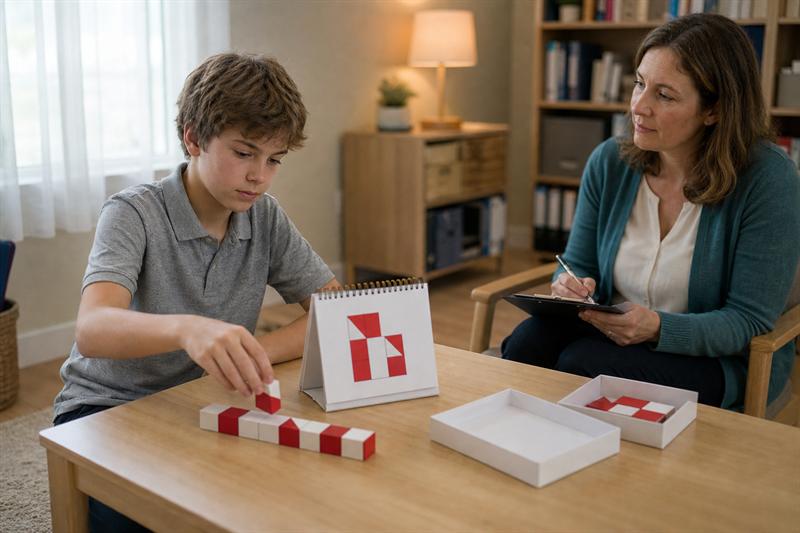
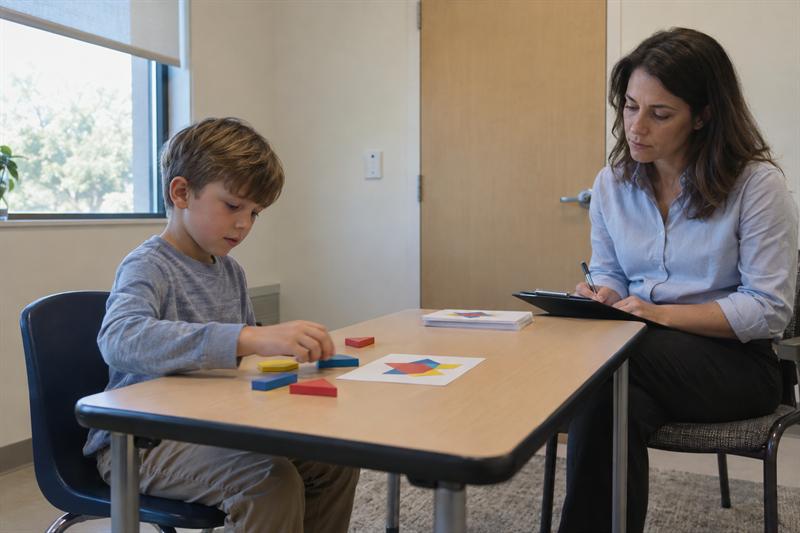
Assessment appointments are where most families picture the evaluation happening: one or more sessions of individually administered testing, spread across a day or two, with the exact number depending on the child’s age, attention, and the scope agreed to at intake. For many school-age children, this is a focused session or two, each lasting a few hours. For some students, particularly those who need more pacing or have a broader scope of assessment, additional sessions may be needed.
What a session actually looks like from the child’s perspective:
- One-on-one time with the evaluator, not a group setting
- A mix of pencil-and-paper tasks, verbal responses, timed activities, and structured problem-solving
- Breaks built into the session; the child can eat, drink, and use the restroom when needed
- Tasks scaled to the child’s age and comfort level. For younger children, some tasks may feel close to play
- The evaluator adjusting pace, offering encouragement, and checking in about frustration
The evaluator is not scoring right or wrong answers the way a school exam does. The observation is about process: how the child approaches a problem, which strategies they reach for, how they handle difficulty, how long it takes them to shift between task types, and whether attention holds when novelty fades. A child who reaches the “right” answer slowly and with heavy prompting tells a different story than a child who gets there quickly but cannot explain the steps. Both patterns are useful. Only one of them shows up on a bubble sheet.
The specific tests selected depend on the concerns identified at intake. The evaluator builds the battery to match the child’s profile rather than administering a fixed set to every student. The full range of areas that may be assessed can span cognitive ability, academic achievement, processing speed, working memory, attention, executive function, and social-emotional functioning. The intake is what determines which areas are relevant.
For young adults entering college or a professional program, the assessment often includes self-report measures, a structured interview about academic history and current challenges, and documentation tailored to what a disability services office will need. The pacing adjusts for an adult scheduling around classes or a job rather than a school day.
Step 4: The Feedback Session
The feedback session, sometimes called a summary or results meeting, is where the evaluation moves from testing to a working plan for the family. It is a scheduled conversation, typically 60 to 90 minutes, between the evaluator, the parent or guardian, and, when appropriate, the child or young adult themselves.
What the session covers:
- A plain-language summary of cognitive and academic findings, organized by domain rather than by test name
- Strengths stated alongside areas of difficulty, not buried after pages of numbers
- The interpretive narrative: what the pattern means in the context of the child’s actual school day, not just their performance on a test
- Recommendations for academic interventions, accommodations, social-emotional supports, and referrals where warranted
- Time for questions, clarification, and discussion of what comes next
The feedback session is not a one-minute results readout. It is a collaborative conversation. The evaluator walks through the findings, and the family is expected to ask questions, push back, request clarification, and talk through what the recommendations mean for a Tuesday afternoon in a third-grade classroom. A useful part of the conversation is that real questions often surface at the feedback session, not during intake. The child may score well on reading fluency but find multi-step written responses difficult. Anxiety may be situational rather than pervasive. Executive function challenges may show up specifically in task transitions rather than as a global difficulty. Those nuances often come out in conversation, not just from a report.
For older adolescents and young adults, the evaluator often includes the student directly in the session. The student hears the findings in plain language and has a chance to respond, ask questions, and understand what the recommendations mean for their next term or semester.
Step 5: The Written Report and Recommendations
The written report is the formal, durable output of the evaluation. It is delivered to the family after the feedback session, once final data are in and the report has been finalized. The report is a working document, not a file that goes in a drawer. Families use it in 504 and IEP meetings, in conversations with college disability offices, in referrals to therapists or learning specialists, and as a reference in future reevaluations.
Typical report structure:
- Referral information and reason for the evaluation
- Summary of background: developmental history, academic history, records reviewed
- Results organized by domain: cognitive, academic, processing, attention, executive function, social-emotional
- Interpretive narrative linking results to the child’s actual functioning in school and at home
- Recommendations section organized by category
The recommendations section is where the report becomes actionable. It typically covers:
- Academic interventions: specific instructional adjustments, skill-building supports, tutoring focus areas
- Classroom and testing accommodations: extended time, reduced-distraction settings, chunked assignments, assistive technology
- Social-emotional or behavioral supports: counseling referrals, executive function coaching, behavioral strategies
- Referrals to other professionals where the data support them: occupational therapy, speech-language therapy, learning specialist, counselor
- Documentation notes for school or college settings, where applicable
The report is shared with the family first. With written consent, it can be sent to the school, a college disability office, a therapist, or any other professional involved in the child’s support plan. It helps a family move from describing concerns in general terms, “my son struggles with focus and writing,” to referencing specific, test-referenced findings with a professional’s interpretation behind them. That shift can change the quality of the conversations that follow.
Common Areas Assessed in a Psychoeducational Evaluation
The scope of any single evaluation is set at intake based on the child’s or student’s specific profile. What follows is the full range of domains a psychoeducational evaluation can examine, organized by category. In practice, the battery is tailored to the child’s needs, and the multi-method approach combines standardized tests, structured interviews, rating scales, records review, and direct observation so that no single number carries the entire interpretation.
Cognitive and academic domains:
- Fluid reasoning and verbal ability
- Processing speed and working memory
- Phonological processing, including phonemic awareness and rapid naming
- Visual-spatial and visual-motor integration
- Reading comprehension, decoding, and fluency
- Math reasoning, calculation, and fluency
- Written expression and spelling
Social, emotional, and behavioral domains:
- Attention, impulse control, and task persistence
- Anxiety, mood, and emotional regulation patterns
- Social functioning and peer relationships
- Adaptive behavior in academic and home settings
- Sensory processing considerations where relevant
Executive function and learning support areas:
- Planning, organization, and time management
- Task initiation and goal-directed persistence
- Self-regulation of behavior and emotion
- Metacognition and use of learning strategies
- Response inhibition and flexibility
The distinction between these areas matters. A child who looks “disorganized” in a classroom may have a specific working memory gap, a task initiation difficulty, or an anxiety response that looks similar from the outside but may call for a different support. The evaluation helps identify the underlying pattern so recommendations can target more than the visible symptom. For a fuller breakdown of the specific measures and domains, see what is included in a psychoeducational evaluation.
How Long Does the Psychoeducational Evaluation Process Take?
From the initial consultation to receiving the written report, the full process often runs four to eight weeks. The range reflects practical variables: how quickly a district returns records, whether a teacher completes a rating scale early or late, whether the child needs an extra session for pacing, and current scheduling.
- Intake meeting: Often scheduled within the first week or two of initial contact. The free initial consultation at Carolina Anchor Psychological & Educational Consulting is the practical starting point.
- Records and questionnaires: Variable, depending on the school’s records process. This is often the stage most likely to add time. District offices process records requests on their own schedule, and teacher forms often wait between grading cycles.
- Assessment appointments: A focused session or two, spread across a week or so depending on the child’s age and the scope of the battery.
- Feedback session: Scheduled after key results are interpreted, often within a few weeks of final testing once the main data are available.
- Report finalization and delivery: The written report is completed and sent after the feedback session, once all rating scales and supporting materials have been reviewed and the narrative and recommendations are finalized.
The timeline that slips is usually the records stage, not the testing. A family that sends the records request promptly after intake and follows up with the school can keep the schedule on track. A family that assumes the school will send materials by the time of the first test may find the schedule shifts. The practical fix is simple: send the request early, follow up by phone, and confirm in writing what is on file at the district.
When Timing Matters in the Evaluation Process
The evaluation itself is not usually the urgent part; the records request, school meeting deadlines, and transition dates are. Starting the process early can help families keep options open, especially when a 504 or IEP meeting or college documentation deadline is already on the calendar.
Specific situations where an earlier intake conversation is often helpful:
- A school has already sent a 504 or IEP meeting notice and the family wants to consider bringing an independent evaluation to that meeting
- The child is in a transition year, such as K to 1, 5 to 6, 8 to 9, or 12 to college, and the next academic setting will likely demand more independent work
- A young adult has a deadline from a college disability office or professional program for documentation before the next term starts
- Grades have dropped over time and the pattern is not explained by a one-off event
If any of these apply, an early intake conversation can help confirm whether an evaluation is appropriate, what the realistic timeline may be, and what should be gathered first. Starting before a school meeting or documentation deadline gives more time to coordinate next steps without deciding in haste.
How to Prepare a Child, Adolescent, or Young Adult for the Evaluation
Preparation is practical, not dramatic. The child is not going to be graded on a school exam. They are going to spend time one-on-one with a professional who is trying to understand how their brain works with academic material. The conversations you have before the session shape how the child walks in.
- Tell the child what is happening in plain language. “You are going to do some puzzles, word games, and problem-solving activities with a professional who wants to understand how you learn.” Avoid the word “test” when possible, and avoid framing it as finding out whether they are “smart enough.” Those frames can turn a neutral task into a performance.
- Normalize the breaks. Tell the child they will be allowed to get up, get a drink, and take a pause whenever they need one. Knowing breaks are built in, rather than needing permission, can reduce anxiety.
- Make sure the child sleeps a full night before and eats a real breakfast. A tired, hungry child may not show their full range on a processing speed task, and although the evaluator is looking at patterns rather than single scores, the data should be as clear as the night before allows.
- Pack a water bottle, a light snack, and any comfort item the child wants nearby. A small fidget, a favorite pen, or a jacket they feel calm in can support baseline comfort and how open the child is during the session.
For adolescents and young adults, the preparation conversation is different. They are old enough to have a stake in the outcome and old enough to resist a process that feels imposed. Frame the evaluation around what they are trying to understand. “You have told me the senior-year workload has been overwhelming and you are not sure why it feels heavier for you than for some peers. This is a way to identify what part of the load is hardest so the next term can be more manageable.” A young adult in college or a professional program can also prepare by thinking ahead about which courses felt hardest, what kinds of assignments drained them, and what they want the documentation to support for the disability office.
In-Person and Telehealth Evaluation Considerations
The format is mostly a logistics and comfort question, not a different quality tier. The core domains assessed, the interpretive process, and the recommendations are designed to be consistent whether the family is in the office or on a video call. What changes is the environment and a small set of practical details.
In-person evaluation:
- Private office setting in Mount Pleasant
- Built-in break space: the child can step into a quiet room or outside for a few minutes
- Direct access to physical materials: writing samples, fine-motor observation, pencil-and-paper tasks without screen mediation
- The evaluator can observe body language, pencil grip, and desk organization in real time
Telehealth evaluation:
- Secure video platform. The family manages a quiet, distraction-free room at home with a stable internet connection
- The same broad range of cognitive and academic measures, adapted for digital delivery where available
- The child eats, drinks, and takes breaks in their own environment, which can reduce anxiety for some students
- Some modalities, such as fine-motor screening or handwriting analysis, require the family to have paper, pencils, and materials visible through the camera
Which format fits depends on the child’s age, the specific areas being assessed, the family’s schedule, and whether the home environment can support a focused session without interruptions. If a younger child is more comfortable at home than in an office, telehealth may help them settle. If the evaluation includes detailed fine-motor or writing observations, in-person gives the evaluator more to work with. The format is confirmed at the intake meeting, after the evaluator has a sense of what the battery will include and how the child is most likely to perform in each setting.
How Evaluation Results Connect to 504 Plans, IEPs, and School Supports
An independent psychoeducational evaluation report does not trigger a 504 plan or an IEP. The school determines eligibility through its own evaluation and review process, using its own documentation, observations, and policy. What the report does is give the family a professionally interpreted, test-referenced set of findings and recommendations to bring to that meeting. That changes the shape of the conversation.
Without the report, a parent may walk into a 504 meeting and say, “My son is struggling with focus and his written work is falling apart.” The school takes notes. With the report, the parent may say, “Here is an independent evaluation showing a processing speed index below the average range, working-memory challenges that affect multi-step written responses, and a specific set of recommended accommodations.” The conversation can shift from subjective observation to documented findings. The school still decides. The family now has a clearer basis for the discussion.
Practical steps after receiving the report:
- Request a meeting with the school’s 504 team or IEP team before the semester settles into a routine. The earlier the meeting, the more support can be in place before the next unit or exam cycle.
- Bring the full report or a summary page, with written consent for the school to review it. It can be helpful to ask the school to note in writing how each category of recommendation is addressed: accepted, modified, or declined with reasoning.
- Use the recommendations as a starting point for the conversation rather than a non-negotiable list. The school may pair your recommendations with its own supports. The goal is a plan that works for the child, not a plan that matches the report line by line.
- If the family is also pursuing outside support, such as learning intervention, executive function coaching, occupational therapy, or counseling, coordinate the evaluation findings with those providers so everyone is working from the same picture.
For young adults in college or professional programs, the report feeds into the disability services documentation process at the institution. Each school has its own intake requirements, and timing matters. A college disability office handling a queue of new students in late summer often works best with documentation submitted before the course load picks up, giving the office time to process it and the student time to receive accommodations before the first exam.
When a Reevaluation May Be Considered
A psychoeducational evaluation captures a child’s or student’s functioning at a point in time. Profiles shift. A second grader who compensates well with heavy support in a small classroom may show a very different pattern in a sixth-grade honors math class. A young adult who entered college with a clear set of accommodations may need a different set of documentation after two years of changing coursework.
Common reasons a reevaluation is considered:
- The student is approaching a major academic transition, such as elementary to middle school, middle to high school, or high school to college, and the demands are shifting in ways the current supports do not cover
- Previous accommodations no longer match the level of support the student needs. The student is managing, but the effort is visible and the margin is shrinking
- A new concern has appeared that the prior evaluation did not address: a behavioral pattern, a social difficulty, or an emotional shift that is affecting academic functioning
- The school is requesting an updated evaluation as part of a periodic IEP review cycle
- A young adult needs refreshed documentation for a new college, graduate program, or other professional program
A reevaluation is not a red flag. It is a normal part of educational support for a student whose needs are still developing. The scope of a reevaluation is often narrower than the original. The evaluator reviews prior reports and testing data first, identifies what has changed or what needs closer attention, and builds the battery around those specific questions. The goal is a current, accurate picture without repeating work that is already documented.
Common Questions About the Psychoeducational Evaluation Process
What should I bring to my child’s psychoeducational evaluation?
The evaluation team typically provides a checklist before the first appointment, but a consistent list includes completed consent forms, recent school records, report cards from the last two semesters, any prior evaluation or testing report, the current 504 or IEP plan if one exists, a water bottle, a light snack, and a comfort item the child wants nearby. For older students and young adults, the one thing worth preparing beforehand is a short list of the courses or academic settings that have felt hardest and what specifically about those settings drained the most energy. The evaluator will ask for that context verbally, and having it ready can make the session more efficient and the interpretation more grounded.
How long will the psychoeducational evaluation take from start to finish?
At Carolina Anchor, the full process often runs four to eight weeks from the first consultation to receiving the written report, with the most common variable being how quickly school records and teacher rating scales come back. The testing itself is often a focused session or two, spread across a week or so. Feedback is scheduled after key results are interpreted. The written report is finalized and delivered after the feedback session, once all forms have been reviewed. The stage that usually stretches the timeline is the records stage, not the testing. A records request sent to the district promptly after intake and followed up by phone can keep the schedule on track. A records request that goes unreturned for an extended period can push the entire process back by a similar amount.
Will my child be “tested” like a school exam?
No. The session is one-on-one with the evaluator, and the tasks look like puzzles, word games, timed problem-solving, and structured activities, not a written exam with a curve. The evaluator is watching process, not just answers: how the child approaches a problem, which strategies they use, how they handle a task that gets harder, and how attention holds when novelty fades. Breaks are built in, not earned. For younger children, some tasks are close enough to play that the child’s immediate reaction may be surprise that this is the “test.” For adolescents and young adults, the format includes more structured tasks and a conversation about academic history, but the one-on-one, no-curve, process-focused approach stays the same.
Can a psychoeducational evaluation be done through telehealth?
Yes, when the specific areas being assessed can be appropriately administered through a secure video platform. The evaluation scope, interpretive process, and recommendations are intended to remain consistent based on format, but the environment changes: the family manages a quiet room at home with a stable connection, and a few modalities, such as fine-motor observation or handwriting analysis, require physical materials visible through the camera. Which format fits depends on the child’s age, the areas in the battery, and whether the home setting will support a focused session. The format is confirmed at the intake meeting, after the evaluator has a clear picture of what the testing will involve.
Does the evaluation report guarantee a diagnosis or school eligibility?
No. The report provides a professional interpretation of the child’s cognitive, academic, and social-emotional profile and includes a diagnostic formulation when the data collected support one. It does not carry automatic weight in a school’s eligibility decision. A 504 plan or IEP is determined through the school’s own evaluation and review process, which weighs the independent report alongside its own documentation and policy. What the report changes is the quality of the conversation. A family walking into a 504 meeting with test-referenced, professionally interpreted findings and specific recommendations is in a different position than a family describing general concerns. The school still makes the determination, and the family now has a clearer, more defensible basis for the discussion.
Key Takeaways
- The psychoeducational evaluation process is a five-stage sequence: intake, records and questionnaires, assessment appointments, feedback session, and written report. It is not a single testing day.
- The total timeline often runs four to eight weeks. The stage that most often adds time is records and questionnaires, not the testing.
- Assessment appointments are one-on-one, process-focused, and adjusted to the child’s age, attention, and the scope set at intake. They are not a written exam.
- The feedback session is where the findings become a working plan. The written report is what the family brings to school meetings, college disability offices, and therapy referrals.
- The process helps separate the visible outcome from the underlying pattern so that recommendations can target the driver of the difficulty, not just the behavior a teacher sees in a classroom.
The Next Step: Starting With an Initial Consultation
Understanding the process does not itself resolve the concern. If the concern is specific, the grades are tracking a downward line, a school meeting is on the calendar, or a college deadline is approaching, the next step is a conversation, not a final decision. The initial consultation at Carolina Anchor Psychological & Educational Consulting is a free, unhurried session where the family lays out what they are seeing, asks the questions they have been holding, and gets a clear picture of what an evaluation would involve for their specific child. It is available in person in Mount Pleasant or through telehealth for families across the broader Charleston area and beyond.
Many families delay not because their concerns are unfounded, but because the next step feels unclear. Starting with an intake conversation can reduce the uncertainty that often stands between recognizing a concern and getting a support plan in place. Start with an initial consultation so the process can align with the school calendar rather than chase it.
Carolina Anchor Psychological & Educational Consulting works with children, adolescents, and young adults across the Mount Pleasant and Charleston area, offering in-person and telehealth evaluations designed to give families a clear, actionable picture they can use in the specific meetings, applications, and support plans already on the calendar.